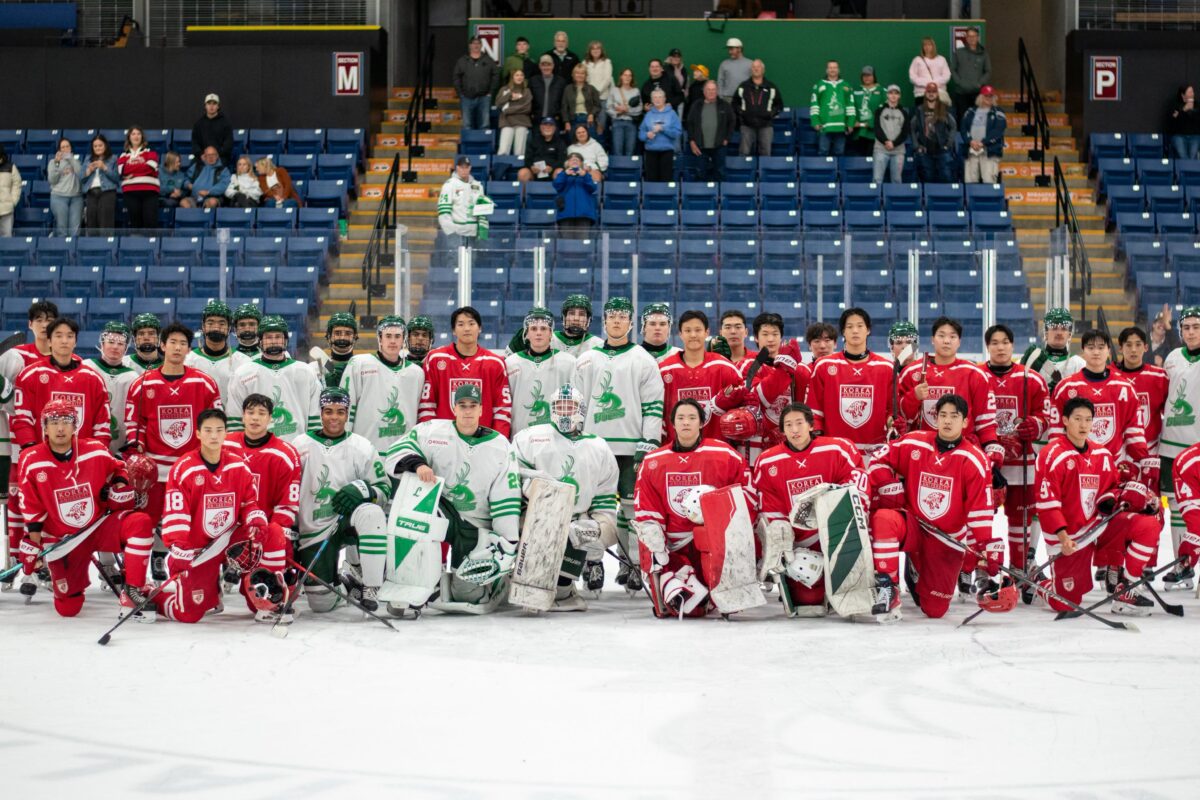
Photo credit: Jacob Brown
Korea University wraps up its three-game tour of the BCHL tonight with a game against the Blackfalds Bulldogs. So far, the team has split their two games, defeating the Cranbrook Bucks 4-3 on Sep. 5 and losing to the Sherwood Park Crusaders 4-3 the following night.
But according to Korea’s assistant coach Jinhyuk Mun, the box score is far from the most important aspect of this trip.
“It’s about more than just wins and losses,” he said. “I hope this experience raises the standards of our players. When you come to Canada and compete against good players and teams, you can clearly see what you need to improve on. It’s not only about technical skills, it’s also about preparation, communication, confidence, decision-making and how you approach the game.”
With increasing opportunities for players outside of North America to come to the BCHL, the league has seen an influx of Korean talent in recent years.
Players like Chongmin Lee (Prince George), Si Hwan Kim (Surrey), Yu Chan Kong (Surrey) and Junsu Kwak (Cowichan Valley/Langley) have all made their mark in the league within the past few years, something that their countrymen back home have noticed.
“It’s been very inspiring, especially for younger players back in Korea,” said Korea University captain Seongsoon Choi. “I think their success has shown young Korean players that there is a pathway to compete at a higher level outside of Korea. It gives them bigger goals to work toward and opens the door for more Korean players to challenge themselves overseas.”
“It can be a great motivation for our players,” added Mun. “It shows them that being Korean doesn’t limit how far they can go. If they have the ability, commitment and preparation, there are opportunities to compete anywhere in the world.”
South Korea may not be known as a hockey hotbed, but it is a country on the rise when it comes to producing talent. The 2018 Winter Olympics in PyeongChang provided a major boost in interest in the sport and the number of people wanting to play.
“Korea may not have a large hockey population compared to countries like Canada, but I think the passion for hockey is strong and the level continues to improve,” said Mun. “We have continued to challenge ourselves internationally, despite having a relatively limited hockey environment. Younger players are also getting better opportunities to train, travel and experience hockey outside of Korea.”
“Korean hockey is still relatively small, but it is growing quickly,” said Choi. “Our passion for the game is as strong as anywhere else in the world. Even though we still have limitations in terms of infrastructure and the overall size of our hockey community, we continue to develop talented players. The overall level of Korean hockey has improved significantly, and our ability to compete on the international stage has become much stronger over the past 10 years.”
When all is said and done, they will have played seven games against BCHL and Alberta Junior Hockey League (AJHL) teams on their tour of Western Canada, and from all accounts, they have already learned a lot.
“One of the biggest things I noticed [about Canadian teams] was the decision-making, attention to small details and overall understanding of the game,” said Mun. “It’s not just about skating speed or individual skills. These players understand where they need to be, what they need to do and they make decisions very quickly depending on the situation. For our players, I think this was a great opportunity to understand how important game experience is in developing hockey IQ and a better understanding of the game.”
“Playing against Canadian teams, I could definitely feel the difference in size, skating speed and overall understanding of how to manage the game,” said Choi. “It has been a great learning experience for us and there are a lot of things we can take away from it. I think our players also feel the difference and it gives them a lot of motivation to improve.”